
2027: 16 contenders battle for the Soul of Lagos
The battle for the control of Lagos State is beginning to assume a new dimension as politicians across the political spectrum position themselves for the 2027 governorship election.

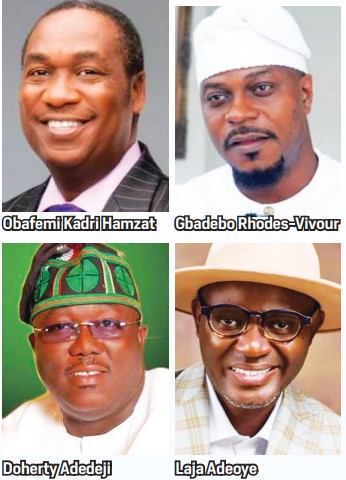
While APC’s Hamzat seeks continuity, Rhodes-Vivour leads opposition charge.
With the field featuring candidates from established opposition parties and lesser-known political platforms, the contest is shaping up as a battle, not only for the Lagos Government House, but also for the political direction of Nigeria’s commercial capital.
At the centre of the contest is the ruling All Progressives Congress (APC), which has presented the incumbent Deputy Governor, Dr Kadri Obafemi Hamzat, as its candidate, with Damilola Sonayon-James as running mate. The APC ticket enjoys the advantage of incumbency, a formidable political structure and the backing of influential party leaders.
The Governance Advisory Council (GAC), the party’s influential leadership body in Lagos, adopted Hamzat as its consensus candidate in April, after Governor Babajide Sanwo-Olu and other party leaders had backed his aspiration.
By June, the party had unveiled Sonayon-James, a Badagry princess and APC Deputy State Woman Leader, as Hamzat’s running mate.
But the opposition is not approaching the election as a mere spectator. Among the opposition candidates, Gbadebo Rhodes-Vivour of the African Democratic Congress (ADC) is arguably the most recognisable name, particularly because of his performance in the 2023 governorship election.
Rhodes-Vivour, popularly known as GRV, contested the 2023 election on the Labour Party platform and became one of the leading opposition figures in Lagos.
In 2027, however, Obi is contesting under another platform, the Nigeria Democratic Congress (NDC), leaving Rhodes-Vivour to construct his own coalition. Rhodes-Vivour insists he is prepared for that challenge.
“Gbadebo Rhodes-Vivour of 2023 is not Gbadebo Rhodes-Vivour of 2026,” he said recently, arguing that he has spent the intervening period building structures across Lagos communities.
He has also argued that Lagos requires a broad-based coalition capable of bringing together different generations, ethnic groups and political interests.
That strategy could prove decisive if opposition parties are able to coordinate their efforts. The major question, however, is whether the opposition can avoid the fragmentation that has historically weakened efforts to dislodge the APC in Lagos.
However, the Peoples Democratic Party (PDP) remains one of the oldest and most recognisable opposition platforms in the state, but its 2027 challenge comes against the background of internal divisions and political realignments.
Its candidate is Doherty Adedeji Olugbemiga, with Khadijat Abike Bello as running mate. The PDP’s challenge is straightforward: convince voters that it remains capable of providing a credible alternative at a time when opposition politics in Lagos is increasingly crowded.
The party must contend not only with the APC but also with the ADC, NDC and Labour Party, among others. The political significance of the PDP’s performance will therefore extend beyond whether its candidate wins.
A strong showing could reshape the opposition balance, while a weak performance could further strengthen calls for a unified opposition platform.
The NDC enters the contest with an important national political development behind it: Peter Obi, the former Labour Party presidential candidate, has moved into the party.
The Lagos governorship candidate is Doherty Olufunsho Adeshina, with Arubiewe Yusuf Abogun as running mate.
The NDC will therefore have to determine how much of the national momentum around Obi can translate into a governorship campaign in Lagos. Unlike a presidential election, a governorship contest is intensely local.
Candidates need ward structures, polling-unit agents, community networks and the ability to mobilise voters beyond social media. That is one of the central tests confronting every opposition party in the state.
The 2023 Shadow
The 2027 contest cannot be fully understood without looking back at 2023. Sanwo-Olu won that election, but Rhodes-Vivour’s strong showing demonstrated that the APC’s dominance could be challenged.
The 2023 election also revealed the importance of youth mobilisation, social media, ethnic and community identities, and the ability of a candidate to build a coalition beyond traditional party structures. Four years later, the political environment has changed.
The APC has retained its organisational advantage, while the opposition landscape has been rearranged through defections, alliances and the emergence of new political platforms.
Rhodes-Vivour’s decision to remain with the ADC after Obi left for the NDC is particularly significant.
He said the opposition needed a coalition because “if we have multiple oppositions it will be difficult to take out this present government.”
That statement captures perhaps the central question of the 2027 Lagos election: can the opposition avoid splitting its votes?
The Other Contenders
Beyond APC, ADC, PDP and NDC, the supplied list features candidates from 12 other parties. The Action Peoples Party (APP) is fielding Adeyemi Abiola, with Olaoye Solomon Adekunle as deputy.
The Action Democratic Party (ADP) has Bolaji Nasir Adewale as its candidate and Ojo Olaojo Samuel as running mate. The National Rescue Movement (NRM) is fielding Onigbokun Ademola Joseph alongside Onanuga Abimbola.
Onigbokun presents an unusual political profile, having built a campaign around infrastructure, housing, healthcare, education, employment and accountability.
His campaign describes his background as an infrastructure and construction professional and promotes what it calls a people-centred development agenda.
The Social Democratic Party (SDP) candidate is Olaniyi Olufemi, with Kayode Evelyn Aderiyike as running mate. The Action Alliance (AA) is fielding Salawu Kamarudeen, with Ganiu Ismail Samuel as deputy.
The African Action Congress (AAC) has Sol-Nuyi Oluwadamola Adesoca as its candidate and Samson Emem Efuntola as running mate. The New Nigeria Peoples Party (NNPP) is fielding Onifade Ademoyegun Taiwo, with Wonopwa Dauda Magagi.
The Allied Peoples Movement (APM) is represented by Adeoye Adelaja Hazeez, with Coker Oluwatobi Adeyemi Grace.
The National Democratic Party (NDP) has Obadiah Akiola as its candidate and Sonitan Grace Motunrayo as running mate. The Labour Party (LP) is fielding Odunaike Oluwapamilerin Olurotimi, with Adele Lateef Adekunle Ayinla.
The Young Progressive Party (YPP) is also in the race, with Anibiniran Iyabode Omolabake listed as the running mate in the supplied field; the governorship candidate was not identified in the information provided.
The Zenith Labour Party (ZLP) candidate is Adenipebi Adelani Oriyomi, with Peter Helen Ojotule as running mate. While several of these candidates may not currently enjoy the visibility of the APC or ADC flag bearers, their presence could still matter.
Elections are not determined only by the candidates who appear strongest on paper. Smaller parties can influence the final result by attracting specific blocs of voters, particularly where the margin between leading candidates is narrow.
The Laja Adeoye Example
The APM ticket illustrates how smaller parties are attempting to build alternative political narratives. Adeoye has been presented by his party as its Lagos governorship candidate and has promoted an “Atunto Eko” agenda.
The party said it uploaded his candidacy on the INEC portal ahead of the February 6, 2027 election. Such candidates will be seeking to turn dissatisfaction with the established parties into electoral support. Their challenge, however, remains structure.
Lagos is a politically sophisticated state with 20 local government areas and a large electorate spread across densely populated urban communities and less urbanised areas. Winning requires more than popularity.
It requires organisation. Several issues could shape the 2027 contest. The first is the performance of the current administration.
The APC will seek to make infrastructure, transportation, technology, urban renewal and continuity central to its campaign. The opposition, on the other hand, is likely to focus on areas where voters feel government performance has fallen short.
Housing, traffic congestion, flooding, environmental management, taxation, public transport, security, employment and the cost of living are likely to feature prominently.
The second factor is voter turnout. A highly motivated political base can produce a decisive advantage in an election where turnout is relatively low. This makes grassroots mobilisation particularly important.
The third is the opposition vote.
If APC opponents contest separately, the ruling party could benefit from vote fragmentation. But if major opposition forces develop an effective alliance, the arithmetic could become considerably more complicated. The fourth is Lagos’ unique political culture.
The state has traditionally rewarded strong political organisation. The APC’s dominance has been built over decades through networks extending from party leaders to local government structures and community-level mobilisation.
The opposition therefore faces the task of matching organisation with organisation. At present, Hamzat appears to possess the strongest organisational advantage.
The APC has already settled its ticket, with the party leadership rallying behind the deputy governor. Governor Sanwo-Olu publicly presented Hamzat and Sonayon-James as the party’s candidates and described them as leaders capable of sustaining Lagos’ development agenda.
The Oba of Lagos, Rilwan Akiolu, has also described Hamzat as intelligent and hardworking and expressed confidence in his capacity to govern the state. But political endorsements do not automatically translate into votes.
The APC must still convince voters that continuity is preferable to change. It must also manage expectations surrounding its performance, particularly among younger voters who increasingly judge government through employment opportunities, technology, transportation, housing and quality of life.
Rhodes-Vivour’s Second Chance
For Rhodes-Vivour, 2027 represents another opportunity to convert the momentum of 2023 into a more durable political movement.
His strongest asset is recognition. His biggest challenge may be the absence of the exact political circumstances that helped the Labour Party in 2023. He insists, however, that he has spent the intervening years building grassroots structures.
“We have been doing the work, we have been building structures in communities, we have entrenched ourselves. We are standing for the people,” he said.
If he succeeds in translating that structure into votes, the election could become significantly more competitive. If he fails, the ADC may find itself splitting an already fragmented opposition vote.
The Real Battle
Ultimately, the 2027 Lagos governorship election may not be a 16-way battle in practical terms. It could become a contest between the APC’s established political machine and whichever opposition candidate succeeds in emerging as the principal alternative.
The other candidates will still matter because every vote counts, and their campaigns could determine how the electorate is divided.
- New Telegraph
What's Your Reaction?
 Like
0
Like
0
 Dislike
0
Dislike
0
 Love
0
Love
0
 Funny
0
Funny
0
 Wow
0
Wow
0
 Sad
0
Sad
0
 Angry
0
Angry
0







Comments (0)