Votes in the Shadow of Violence: Can Nigeria secure an election before it secures its people?

Nigeria is approaching another defining electoral moment, but beneath the familiar noise of political rallies, party manoeuvring and campaign promises lies a more frightening question: Can Nigerians freely participate in an election when too many citizens are still struggling simply to remain safe?

29 Sep 2026 - 19:46
Updated: 10 hours ago
0 1
Votes in the Shadow of Violence: Can Nigeria secure an election before it secures its people?
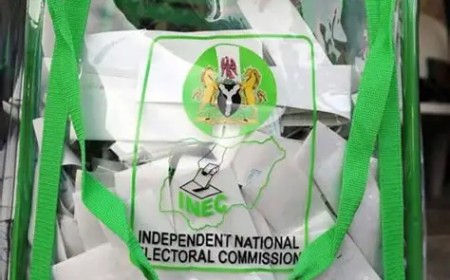
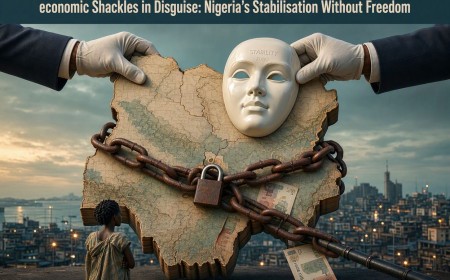
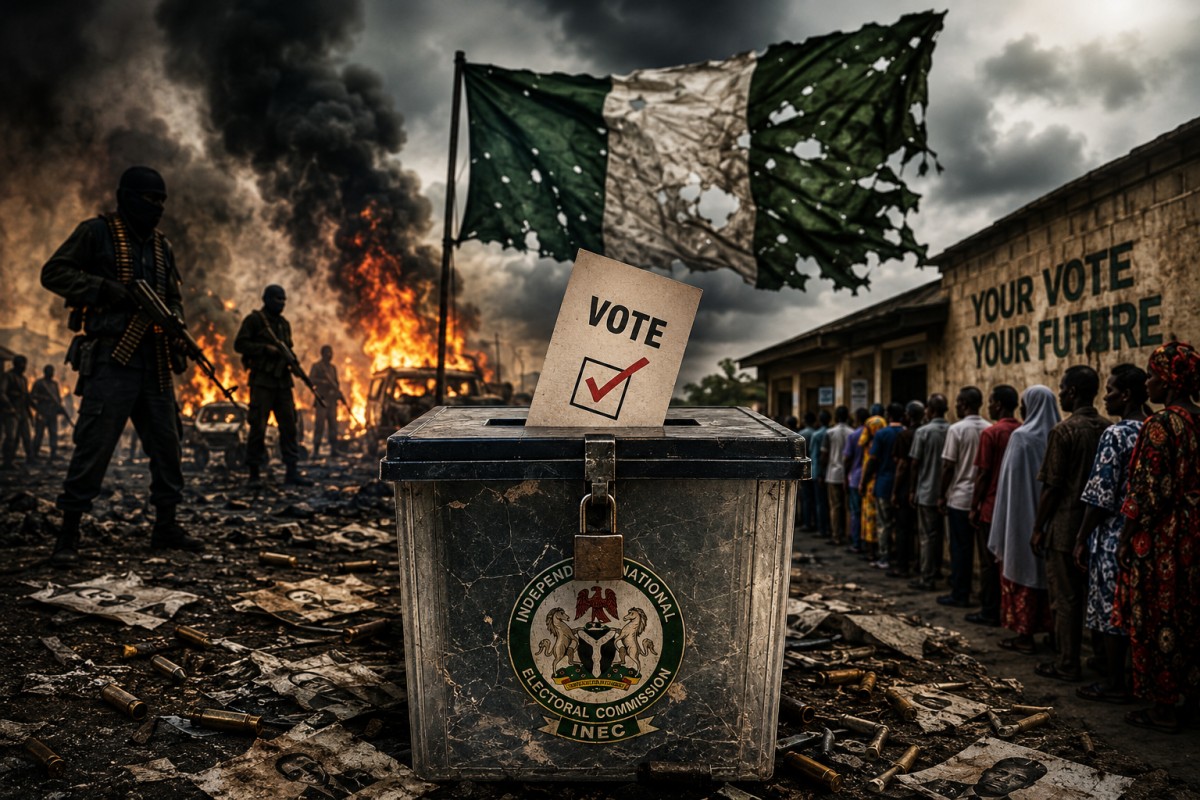
Ballot box and Nigerian voters amid a dramatic representation of insecurity ahead of the 2027 general elections.

Opinion Editorial | By Chuma Mmeka

Nigeria is approaching another defining electoral moment, but beneath the familiar noise of political rallies, party manoeuvring and campaign promises lies a more frightening question: Can Nigerians freely participate in an election when too many citizens are still struggling simply to remain safe?

The question is no longer theoretical.

The Independent National Electoral Commission (INEC) has scheduled the Presidential and National Assembly elections for January 16, 2027, followed by the Governorship and State Houses of Assembly elections on February 6, 2027. The electoral timetable is therefore no longer a distant administrative document. It is a countdown.

And Nigeria's security situation demands that the countdown be taken seriously.

THE BALLOT CANNOT THRIVE WHERE FEAR REIGNS

An election is much more than a ballot paper, a polling unit and an electoral officer.

An election begins with a citizen being able to leave home without fear.

It requires a farmer to travel from his village to a registration centre. It requires a student to return home safely to vote. It requires an elderly voter to reach a polling unit without encountering armed men. It requires political parties to campaign without their supporters being attacked. It requires electoral officials to move sensitive materials without becoming targets. It requires journalists, observers and party agents to operate without intimidation.

Above all, it requires citizens to believe that the state is capable of protecting them while they exercise their constitutional rights.

That is precisely where insecurity becomes an electoral problem.

INEC itself has acknowledged the connection. In a March 2026 address, its Chairman, Professor Joash Amupitan, described security and elections as inseparable, warning that without a secure environment, the sovereign will of the people is threatened. He also identified insurgency, communal conflict, electoral violence, vote trading and emerging digital threats as overlapping challenges to the 2027 process.

That warning should not be buried beneath the usual political noise.

NIGERIA'S SECURITY CRISIS IS NOT WAITING FOR ELECTION DAY

The uncomfortable reality is that insecurity does not suddenly appear when INEC opens a polling unit.

It is already there.

Nigeria continues to contend with Islamist insurgencies in the North-East, expanding banditry and kidnapping in the North-West and North-Central zones, communal and farmer-herder violence, cult and political militias, and other forms of armed instability. Conflict-monitoring organisation ACLED describes the country's security environment as involving several overlapping sources of violence, with banditry spilling beyond the North-West and other forms of instability occurring across the country.

ACLED has also reported more than 300 clashes involving Boko Haram and ISWAP in the Lake Chad region during the first quarter of 2026, representing a 30 per cent increase over the previous quarter.

These figures should not be treated merely as statistics for security conferences.

Every statistic represents a community.

Every displaced family represents a voter.

Every kidnapped traveller represents a citizen whose confidence in the state has been shaken.

Every deserted village represents a potential polling community where democratic participation becomes more difficult.

And every attack on a political gathering, campaign convoy, electoral office or polling location has the potential to transform an election from a contest of ideas into a contest of survival.

THE MOST DANGEROUS VOTER IS THE FRIGHTENED VOTER

There is another dimension to insecurity that deserves far greater attention: voter suppression through fear.

A gun does not necessarily have to be fired inside a polling unit to affect an election.

Sometimes the mere knowledge that violence is possible is enough.

If a resident believes that travelling to a polling unit could expose him or her to kidnapping, attack or communal violence, that citizen may stay home.

If a community has been displaced by conflict, its residents may no longer be anywhere near their original voting locations.

If a political party is unable to campaign safely in an area, its candidates may effectively become invisible to the electorate.

If election officials fear entering particular communities, the integrity and reach of the electoral process become compromised.

This is why insecurity should not be discussed merely in terms of the number of security personnel that can be deployed on Election Day.

The real question is whether Nigerians will feel sufficiently secure to participate before, during and after the election.

The International Republican Institute's August 2026 assessment of Nigeria's 2027 elections similarly identified insecurity, election-related violence, economic hardship and declining institutional confidence as significant challenges to meaningful democratic participation. It specifically warned that displaced voters and communities affected by terrorism and insecurity require particular attention.

That is a warning worth listening to.

A POLLING UNIT CANNOT BE AN ISLAND OF SECURITY

There is a temptation to imagine that election security begins and ends with deploying policemen and other security personnel around polling units.

That approach is dangerously inadequate.

Election security begins months before voting.

It starts with intelligence.

It involves monitoring threats against candidates, political parties, electoral officials and communities.

It requires securing INEC offices and election materials.

It requires protecting voter-registration and voter-education activities.

It requires identifying communities where insecurity could prevent citizens from participating.

It requires safe transportation of electoral personnel and materials.

It requires rapid-response capacity.

And it requires security agencies to act professionally, impartially and within the law.

INEC's Inter-Agency Consultative Committee on Election Security has already emphasised the need for early planning, intelligence gathering, inter-agency coordination and adequate deployment. The Commission has also stressed that no amount of administrative preparation can substitute for effective security coordination.

This is the point at which rhetoric must give way to preparation.

THE SECURITY AGENCIES CANNOT BE ALLOWED TO ARRIVE LATE

Nigeria has perfected the habit of reacting to crises.

An attack occurs.

Condemnation follows.

A rescue operation is announced.

Security chiefs promise that perpetrators will be brought to justice.

Officials assure Nigerians that the situation is under control.

Then another attack occurs.

That cycle cannot be allowed to become Nigeria's election-security strategy.

The 2027 elections will require something different: anticipatory security rather than emergency security.

The police, military, intelligence services and other relevant agencies need credible threat assessments for every high-risk electoral environment.

They need contingency plans.

They need reliable communication systems.

They need clearly defined responsibilities.

They need rapid-response arrangements.

And perhaps most importantly, they need public confidence.

The Inspector-General of Police, Olatunji Disu, has already called on senior police officers to prepare for the 2027 elections, emphasising professionalism, intelligence and accountability in election security.

The message is appropriate.

But Nigerians will ultimately judge election security not by the number of speeches delivered before the election, but by what happens when the first threat emerges.

AND THEN THERE ARE THE POLITICAL ACTORS

Let us be brutally honest.

Security is not solely the responsibility of the police, military or intelligence agencies.

Political actors also carry enormous responsibility.

Nigeria's political class has historically had a complicated relationship with violence.

When elections become existential battles—when losing an election is portrayed as the end of everything—politics becomes dangerously combustible.

Political parties must therefore restrain their supporters.

Candidates must reject inflammatory rhetoric.

Party agents must understand that an election is not warfare.

Supporters must not be transformed into foot soldiers.

And politicians must stop treating young Nigerians as expendable instruments of political competition.

The principle should be simple:

No political ambition is worth one Nigerian life.

That principle applies equally to the ruling party, opposition parties and every candidate seeking public office.

THE ELECTION MUST NOT BECOME A REFERENDUM ON WHO CAN CREATE MORE FEAR

There is another danger.

Insecurity can become politically weaponised.

One side may blame the government.

Another may blame opposition politicians.

Another may blame ethnic or religious groups.

Another may blame foreign actors.

Another may exploit every attack for political propaganda.

Meanwhile, ordinary Nigerians remain trapped between competing narratives while demanding the most basic thing imaginable: safety.

The responsible approach is to investigate individual incidents, establish evidence, identify perpetrators and prosecute offenders—rather than collectively assigning blame to entire communities or political constituencies.

This is particularly important in the age of social media and AI-generated misinformation.

INEC has already identified AI-driven disinformation, social-media volatility and foreign information manipulation as additional challenges that can compound physical insecurity.

Imagine the combustible combination:

A real security incident + a fabricated video + inflammatory political rhetoric + ethnic suspicion + millions of frightened citizens.

That combination can destabilise an election faster than any malfunctioning electoral machine.

THE DISPLACED VOTER MUST NOT BECOME AN INVISIBLE NIGERIAN

One of the most disturbing consequences of prolonged insecurity is displacement.

People flee.

They leave their homes.

They lose property.

They relocate to camps or host communities.

And sometimes, in the process, they become practically disconnected from the electoral system.

This is not merely a humanitarian issue.

It is a democratic issue.

A citizen does not lose his or her constitutional identity because violence forced that person from home.

The IRI assessment has specifically called for improvements to the framework for internally displaced voters, including efforts to enable displaced Nigerians to register or transfer registration so they can participate in elections.

That conversation deserves urgency.

A democracy that counts citizens when it needs their taxes but cannot adequately accommodate them when displacement prevents them from reaching their traditional polling locations has a serious institutional problem.

INEC CAN ORGANISE THE ELECTION. IT CANNOT SECURE NIGERIA ALONE.

This distinction is crucial.

INEC has responsibility for administering elections.

But INEC cannot defeat bandits.

It cannot dismantle terrorist networks.

It cannot secure every highway.

It cannot end communal conflict.

It cannot prosecute criminals.

It cannot single-handedly protect every electoral officer.

The responsibility is broader.

Government must create the security environment.

Security agencies must protect the electoral process.

Political parties must control their supporters.

The judiciary must provide credible avenues for electoral disputes.

Civil society must monitor.

The media must inform rather than inflame.

And citizens must reject violence as a legitimate instrument of political competition.

That is what a functioning electoral ecosystem looks like.

THE REAL TEST OF 2027 MAY BEGIN BEFORE THE FIRST BALLOT IS CAST

Nigeria has time.

But not unlimited time.

The presidential and National Assembly elections are scheduled for January 16, 2027, with the governorship and State House of Assembly elections scheduled for February 6.

The question is not whether Nigeria will hold an election.

The more important question is:

What kind of election will Nigeria hold?

An election where citizens walk confidently into polling units?

Or one where communities remain indoors because of threats?

An election where candidates debate policies?

Or one where violence determines who can campaign?

An election where displaced citizens are deliberately brought back into the democratic process?

Or one where insecurity silently erases their votes?

An election where security agencies protect everyone impartially?

Or one where citizens fear the very institutions deployed to protect them?

These questions cannot be postponed until election morning.

NO MORE EXCUSES

Nigeria cannot continue treating insecurity as an unfortunate background condition while proceeding with business as usual.

There must be measurable preparation.

There must be transparent threat assessment.

There must be adequate protection for electoral personnel and materials.

There must be protection for vulnerable communities.

There must be mechanisms for displaced voters.

There must be rapid response to threats.

There must be accountability for perpetrators of election violence.

There must be consequences for politicians who sponsor or encourage violence.

And there must be sustained public communication so Nigerians know what is being done to protect their participation.

Most importantly, security must not become an excuse for arbitrary restrictions on legitimate democratic activity. The objective is not to militarise the election. The objective is to secure the citizen while preserving the citizen's democratic freedoms.

That distinction matters.

THE BALLOT IS NOT BULLETPROOF

Nigeria's democracy has survived military rule, economic crises, communal conflicts, electoral disputes and political upheavals.

But democracy should not be tested endlessly by asking citizens to choose between exercising their rights and protecting their lives.

The ballot paper is supposed to be an instrument of peaceful choice.

It should never become a piece of paper that a citizen is too frightened to collect.

The polling unit should be a place where Nigerians meet as equal citizens—not a potential theatre of violence.

The electoral officer should be a servant of democracy—not a target.

The voter should be a participant—not a hostage to insecurity.

And political ambition should never be allowed to become an excuse for bloodshed.

Nigeria's 2027 elections are approaching.

The countdown has begun.

But before the politicians ask Nigerians for their votes, the Nigerian state must demonstrate that it can protect the people whose votes it seeks to count.

Because a democracy cannot be considered secure merely because ballot boxes arrive at polling units.

Democracy is secure when the people are secure enough to walk there.

And that is the question Nigeria must answer before the first ballot is cast.

Not after.

Chuma Mmeka (T-Char) is a Nigerian creative, social commentator, and fiery critic. Known for weaving literature, spirituality, and cultural insight, he champions cultural preservation while challenging societal norms. His eloquent works inspire reflection on faith, humanity, and truth, marking him as a bold voice of integrity and imagination.

What's Your Reaction?

Like Like 0
Dislike Dislike 0
Love Love 0
Funny Funny 0
Wow Wow 0
Sad Sad 0
Angry Angry 0

Comments (0)

User