
Benue Farmers Builds New Future Beyond Seeds
In the farming communities of Gboko Local Government Area of Benue State, the beginning of a planting season often comes with both optimism and uncertainty. For smallholder farmers, the hope of a good harvest depends not only on the amount of land cultivated, but also on the quality of seeds planted, knowledge of modern farming practices and the ability to adapt to changing climatic conditions. Increasingly, however, climate change is adding another layer of uncertainty to traditional farming systems.

Sorghum is naturally more tolerant of heat and drought than many other cereal crops, but traditional varieties are not immune to increasingly extreme and unpredictable weather conditions. Changes in rainfall patterns, prolonged dry spells, flooding, rising temperatures, pests and diseases are creating new challenges for farmers who depend heavily on saved traditional seeds.
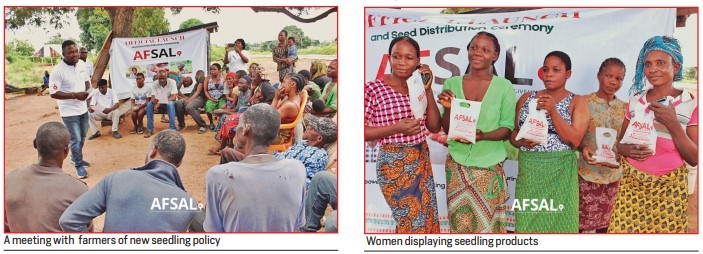
It is against this background that the Atov Foundation for Sustainable Alternative Livelihood (AFSAL) has commenced an agricultural intervention in Mbanom, Mbaikya, Mbayion, Gboko, with the distribution of improved sorghum seeds to smallholder farmers. This intervention for AF- SAL, is not simply a seed dis- tribution exercise. It is an attempt to address some of the challenges that continue to limit agricultural productivity and resilience in rural communities.
Disruptions in rainfall calendar
For generations, farmers have relied on traditional knowledge and established planting calendars to deter- mine when to prepare their farms and sow their crops. Climate variability is gradually making that predictability more difficult. Rain may arrive later than expected, stop for several weeks or become concentrated within short periods. Such irregular rainfall can affect the germi- nation of traditional sorghum seeds and expose young crops to moisture stress at critical stages of development.
For a smallholder farmer, a failed germination period can mean additional expenditure on seeds and labour, while prolonged dry spells can threaten an entire season’s investment. Longer periods of drought are also becoming a concern. Higher temperatures increase the rate at which water is lost from the soil and plants.
When drought occurs during flowering and grain formation, traditional sorghum varieties may produce fewer or smaller grains, ultimately reducing household food supplies and farm income. Research efforts in Nigeria are increasingly focused on identifying sorghum lines capable of maintaining productivity under drought conditions, highlighting the growing importance of climate-resilient planting materials.
… dangers of too much rainfall, less rain
While drought presents one challenge, excessive rainfall and flooding create another. Parts of Benue State are particularly exposed to flooding, which can severely affect agricultural communities. Heavy rainfall can waterlog farmland, wash away seeds and seedlings, delay planting and harvesting, and create conditions favour- able for crop diseases.
For farmers who save and reuse traditional seeds from one season to another, increasing pest and disease pressure adds another layer of risk. The implication is clear: farmers need not only seeds that can produce good yields, but planting materials that are better suited to changing environmental conditions.
Adzer: Establishing enduring relationship
Speaking during the launch of the intervention, AFSAL Chief Servant, Yadoo Adzer said the Foundation’s entry into Benue marked the beginning of a long-term relationship with communities.
She explained that the organisation was established to support practical solutions capable of helping people become more productive, resilient and economically secure. “We believe sustainable development must create opportunities for people to become more productive, resilient and economically secure,” Adzer said. The choice of agriculture as one of the Foundation’s entry points is significant in a state widely recognised for its dependence on farming.
For communities where agriculture remains the principal source of livelihood, improving access to quality inputs could have implications that extend beyond individual farms. It could mean better food production, stronger household incomes and greater economic stability. But in the face of climate change, the question is no longer simply whether farmers have access to seeds.
It is whether the seeds, farming methods and knowledge available to them are capable of responding to changing environmental conditions. Sesugh: Tasked on effective use of materials AFSAL Programme Manager, San Sesugh, said the Foundation’s approach would combine the distribution of improved seeds with farmer education and monitoring.
He urged beneficiaries to apply the lessons from the sen- sitisation sessions and make effective use of the improved planting materials. “Food security begins with the farmer, and supporting farmers means supporting the future of our communities,” Sesugh said. The Foundation plans to train beneficiaries in Best Agronomic Practices and conduct field visits to monitor planting and germination. It will also collect data to assess harvest outcomes.
This follow-up component could prove crucial because the impact of improved seeds cannot be fully determined at the point of distribution. Their real value will become clearer when farmers harvest their crops and are able to compare the results with previous seasons. It could also provide useful evidence on how the improved varieties perform under the changing climatic conditions experienced by farmers in the area.
Communities welcome support
Community leadership has embraced the intervention. The traditional ruler of the host community, Zaki Tarkaa Torpuu commended AFSAL for bringing the programme to Mbanom. He pledged the community’s cooperation. “Agriculture is central to the livelihoods of our people, and interventions that give farmers access to better inputs and knowledge are valuable,” he said. Among the farmers, the intervention has generated expectations for a more productive farming season.
Beneficiaries commend intervention Beneficiaries of the programme commend AFSAL for the intervention, with one of them, Terkula Dooshima, describing access to improved seeds as an important opportunity and urged the Foundation to expand the programme to reach more farmers. “We hope this programme continues and reaches more farmers, alongside the training and follow-up support needed to achieve good results,” Dooshima said. She added: “We appreciate AFSAL for coming to our com- munity and supporting farmers with improved seeds.
Access to good inputs can make a real difference to farmers.” The intervention reflects a growing recognition that im- proving agriculture requires more than providing inputs. Farmers need knowledge, regular technical guidance and support to understand how to maximise the potential of improved varieties, particularly as climate change alters the conditions under which crops are grown.
The effectiveness of the intervention will therefore depend partly on what happens after the seeds leave the distribution point. To address this, Sesugh said AFSAL would maintain contact with beneficiaries through practical training on Best Agronomic Practices, field visits to monitor planting and germination, as well as data collection to assess harvest outcomes.
Such follow-up, the Founda- tion believes, will provide an opportunity to identify challenges early and generate evidence on the effectiveness of the interven- tion. For farmers dealing with irregular rainfall, drought, flooding, rising temperatures and changing pest and disease patterns, such technical support could be as important as the seeds themselves.
The road ahead
AFSAL is considering expanding its seed distribution programme to other farming communities across Benue State, potentially extending the benefits of improved agricultural inputs and technical knowledge to a wider population.
If sustained, the programme could gradually move from a single-community intervention into a broader agricultural support initiative, linking improved planting materials with practical knowledge, climate adaptation and evidence-based monitoring.
For the farmers of Mbanom, however, the immediate task is much simpler: take the improved seeds to the fields, apply the knowledge provided and wait for the harvest.
The success of that harvest may ultimately tell the most important part of the story – whether a bag of improved seeds can become the beginning of a more secure livelihood for a smallholder farmer and a practi- cal response to the growing pressures of a changing climate. For AFSAL, the bigger ambition appears to go beyond one farming season: to help rural communities build agricultur- al systems that can withstand uncertainty, adapt to changing conditions and provide more sustainable livelihoods for the future.
- New Telegraph
What's Your Reaction?
 Like
0
Like
0
 Dislike
0
Dislike
0
 Love
0
Love
0
 Funny
0
Funny
0
 Wow
0
Wow
0
 Sad
0
Sad
0
 Angry
0
Angry
0









Comments (0)